For students
What a score does and does not mean, and what to do if your work is flagged.
A guide-led site for students, teachers and writers
Learn what AI text (and image) detectors claim to measure, why false positives happen, and how to treat a score as a signal rather than proof. Sources were checked on 18 November 2026. Editorial wording is AI-drafted and still needs a human fact-check.
What a score does and does not mean, and what to do if your work is flagged.
How to treat a result fairly, write a clearer policy, and avoid using a score as proof.
How editors and SEO publishers can treat a score, and what official Google guidance actually says.
Guide
Perplexity and burstiness are useful ideas to understand, but many current tools describe classifiers or other methods. A score is still not proof.
Guide
A false positive is human writing flagged as AI. Research and official vendor pages show this can happen, including for some non-native English writing.
Guide
Stay calm, keep your drafts, read the policy, and ask for a conversation. A score is not proof, and official sources say it should not stand alone.
Guide
Treat a flag as a prompt for professional judgement, not a misconduct decision. Official sources say the score should not stand alone.
Guide
Fair policy states what AI use is allowed, treats detector output as contestable, and does not let a score stand alone.
Guide
Plagiarism checking looks for copied text in a database. AI detection looks for patterns it associates with machine writing. They answer different questions.
These are short, task-based pointers to official detector websites — not a ranking and not a second product catalogue. We have not hands-on tested these tools. A fuller product directory may be published separately later; this site does not link to unpublished domains.
For students checking their own draft before they submit
A free official checker, with a 1,200-word limit per submission, that students can use on their own draft. It is not proof that a paper will pass a school’s review.
For writers who want a free official check, with unusually clear “signals, not verdicts” language
A free official detector that, on its own site, tells users never to make an academic or employment decision on a score alone.
For teachers and students who need a self-serve education-oriented official tool, still only as a conversation starter
An official education-oriented detector whose own FAQ says results should not be used to punish students and should flag a conversation, not end one.
For writers already working in Grammarly, who need to know that scores can differ across tools
An official detector inside a writing tool, with a published warning that the percentage is not an objective source of truth and may differ from other detectors.
For teachers whose institution already provides Turnitin
An institutional tool. Official Turnitin guidance says it does not determine misconduct and that instructors must apply professional judgment because the false-positive rate is not zero.
For editors and publishers checking content they intend to publish
An official checker aimed in part at publishers and teams. Its own site says an AI score should not be used alone for academic integrity discipline, and notes a 100-word minimum.
This site explains how AI detection works and how to use it responsibly. It is written for students, teachers and writers. It is not a product catalogue, not a ranking of detectors, and not a paste-your-text checking app.
Start with an audience hub or a guide, then follow the citations. Every important claim should have a source URL and a check date. Visit buttons to official tool websites, if you use them, always go to the vendor’s own site. If an affiliate_url has been added after a programme on Impact, PartnerStack or Awin is joined, the visit link is labelled Werbung / AnzeigeAffiliate link and uses rel="sponsored noopener". Until then, the button falls back to the plain official URL.
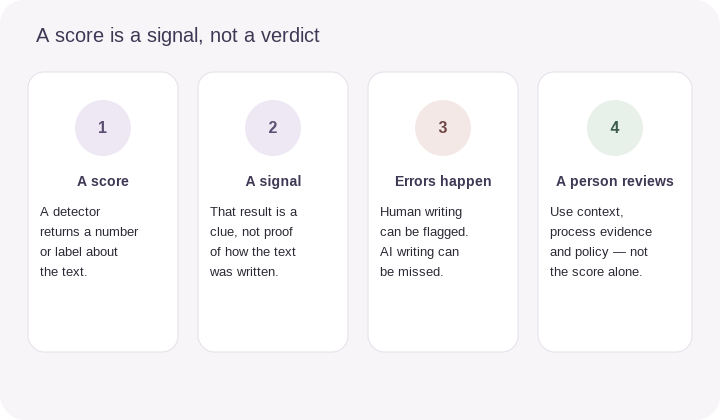
A detector result can be a useful prompt for a conversation. Official vendors, universities and research papers cited here repeatedly warn that it should not be the only evidence in a high-stakes decision.
Read How we review and the sources list before you treat a page as advice. All guides · FAQ · Suggest a correction
No. This is a guide-led educational site. A short “tools we point to” section links to official vendor websites for specific tasks, but it is not a catalogue or a ranking.
No. We have not hands-on tested products unless a testing-notes box is later filled in after a real test.
Not on its own. Published research, official vendor pages and at least one university policy cited on this site treat a score as incomplete evidence. Human writing can be flagged, and AI writing can be missed.
No. We only cite sources we opened and checked on 18 November 2026, with a URL. If we could not verify a figure, we left it out.