For students checking their own draft before they submit
Scribbr AI Detector
A free official checker, with a 1,200-word limit per submission, that students can use on their own draft. It is not proof that a paper will pass a school’s review.
Audience hub
A detector score is not a grade and not automatic proof of cheating. Start with your course policy, keep your drafts, and use the guides below if you need to understand a result.
Main keyword: AI detection for students. This is educational guidance, not legal, academic-conduct or employment advice.
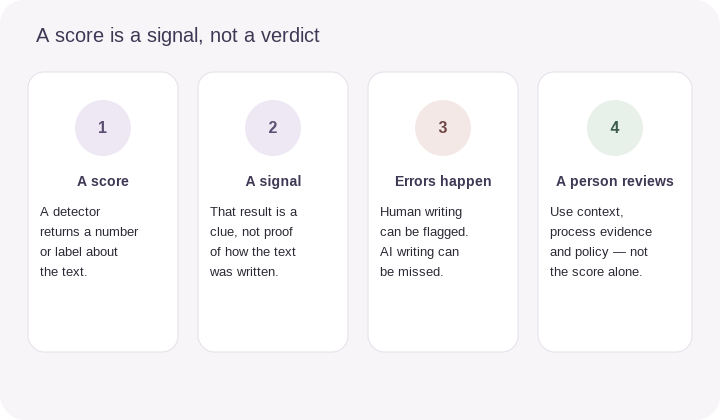
If you are trying to understand a result, read AI detection for students and How to read an AI detector score. If you believe your own writing has been flagged in error, use If you are falsely flagged. That guide is about process evidence and a fair conversation. It is not a paste-your-text app and not legal advice.
Official pages cited across those guides say a score should not be used alone in an academic decision. GPTZero says results should not be used to punish students. QuillBot says never to make an academic decision on a score alone. Turnitin says it does not determine misconduct. Your syllabus still matters more than this website: it tells you what AI use, if any, is allowed.
You should know that researchers have documented a risk of false positives on some non-native English writing. Liang and colleagues (2023), in the arXiv PDF we opened, reported an average false-positive rate of 61.22% on 91 human-written TOEFL essays across seven detectors in that experiment. That paper does not automatically decide your case, but it is a reason to ask for more than a score. Details are in Why false positives happen.
For students checking their own draft before they submit
A free official checker, with a 1,200-word limit per submission, that students can use on their own draft. It is not proof that a paper will pass a school’s review.
For writers who want a free official check, with unusually clear “signals, not verdicts” language
A free official detector that, on its own site, tells users never to make an academic or employment decision on a score alone.
For teachers and students who need a self-serve education-oriented official tool, still only as a conversation starter
An official education-oriented detector whose own FAQ says results should not be used to punish students and should flag a conversation, not end one.
No. Official pages say no detector is fully reliable, and tools can disagree with the one your school uses.