Guide
How teachers can use results fairly
Main keyword: AI detection for teachers. This is an educational guide, not a hands-on test and not a paid ranking. Sources were checked on 2026-11-18 unless a citation says otherwise.
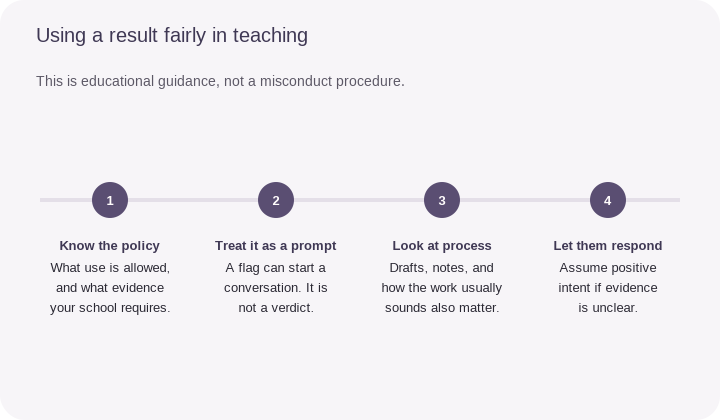
A score is not a finding of misconduct
If you teach, the fairest starting point is the one several official sources already publish. Turnitin’s official blog says the company “does not make a determination of misconduct,” and that because the false-positive rate “is not zero, you as the instructor will need to apply your professional judgment, knowledge of your students, and the specific context surrounding the assignment.” GPTZero’s official FAQ says results “should not be used to punish students” and are intended to flag a conversation. QuillBot’s official page says never to make an academic decision on a detector score alone.
Institutional policy can go further. The University of Missouri’s official AI Detection Tools page, checked on 18 November 2026, states that it is the opinion of the Faculty Council that AI detection software reports “should not be the sole evidence used for reporting students or misconduct proceedings,” and that faculty should investigate concerns through traditional methods. Your campus policy may be worded differently. Read it before you act, and do not import another university’s rule as if it were yours.
Say in advance what is allowed
Turnitin’s official tips begin with “know before you go”: consider false positives in advance, have a plan, and communicate it so that expectations are shared. Jisc’s official principles for FE colleges, written with the Association of Colleges, say all colleges should provide clear guidance to learners on appropriate use of AI, including general principles and more specific guidance at assessment level. The same Jisc page says that where detection tools are used, “staff will be given training and guidance to help understand these limitations.”
Clear advance rules also reduce the temptation to treat a detector as a surprise trap. If some AI use is allowed — for brainstorming, for example — say so, and say how it should be acknowledged. The MLA Style Center’s updated guidance (published 13 August 2025), which we opened on 18 November 2026, tells writers to cite generative AI when they incorporate its content and to acknowledge functional uses such as editing or translation in a note or in the text. That is citation guidance, not a school policy, but it is a public standard you can point to when you ask students to disclose use.
If a flag appears, look at process and give the student a chance to respond
Turnitin’s official blog asks instructors to assume positive intent and, if the evidence is unclear, to give students “the strong benefit of the doubt.” It also asks instructors to be open that a false positive may occur. GPTZero’s official FAQ suggests asking the student to demonstrate understanding in a controlled setting, to share drafts or revision histories, and to look for a long-term pattern rather than a single instance.
Jisc’s official principles include contestability: if AI systems are used in ways that affect learner outcomes, including “the use of AI detection in assessment processes,” colleges should ensure learners and staff have clear guidance on how to contest the output if they feel unfairly disadvantaged. Building that path before a difficult case is fairer than inventing one in the middle of it.
Be especially careful with writers who are working in a second language, with short or highly formal assignments, and with text that has been through grammar or rewrite tools. Those are documented risk areas in the false positives guide, including the 2023 Liang et al. study on TOEFL essays. A detector disagreement is also possible: Grammarly’s official user guide warns that its scores may differ from Turnitin, GPTZero or Copyleaks.
Limits that official sources already admit
Jisc’s official principles put the overall caution in one paragraph that is worth quoting in full from the page we opened: “Whilst AI detection tools may have a part to play in maintaining academic integrity, they are by no means a full solution.” The same paragraph says there is a risk that AI detection “can unfairly discriminate and can compound existing bias,” and that users need a clear understanding that such systems “cannot conclusively prove text was written by AI, generate false positives, and are easy to defeat.”
This hub is about fairness, not about choosing a product. If your institution already provides a tool, learn that vendor’s official limits. If you are exploring a self-serve option as a conversation starter, read the official caution on the short entry first. This site does not claim to have hands-on tested classroom software.
Frequently asked questions
Can I rely on a high AI score as the only evidence in a misconduct case?
Official sources cited here say no, or say the score is not a determination of misconduct. At least one university policy we opened says a detection report should not be the sole evidence. Follow your own institution’s rules.
What should I tell students in advance?
Say what AI use is allowed, how it should be disclosed, and that a detector — if you use one — can be wrong and will not be the only evidence. Turnitin and Jisc both emphasise clear expectations.
Sources checked for this guide
- Turnitin, “Understanding false positives in Turnitin AI detection”. Checked on 2026-11-18.
- GPTZero official FAQ. Checked on 2026-11-18.
- QuillBot official AI Detector page. Checked on 2026-11-18.
- University of Missouri, “AI Detection Tools” (AI @ Mizzou). Checked on 2026-11-18.
- Jisc, “Principles for the use of AI in FE colleges”. Checked on 2026-11-18.
- MLA Style Center, “How do I cite generative AI in MLA style? (Updated and Revised)” (published 13 August 2025). Checked on 2026-11-18.
- Grammarly Support, “AI Detector user guide”. Checked on 2026-11-18.
- Liang, Yuksekgönül, Mao, Wu and Zou, “GPT detectors are biased against non-native English writers,” arXiv:2304.02819 — We opened the arXiv abstract and the PDF (v3, 10 July 2023) on 18 November 2026. The authors point to the published Patterns article at https://www.cell.com/patterns/fulltext/S2666-3899(23)00130-7. Numbers quoted in the guides come from the arXiv PDF we opened, not from a Cell HTML full-text page.. Checked on 2026-11-18.
Related guides
- Policy and ethics of AI detection — Fair policy states what AI use is allowed, treats detector output as contestable, and does not let a score stand alone.
- If you are falsely flagged — Stay calm, keep your drafts, read the policy, and ask for a conversation. A score is not proof, and official sources say it should not stand alone.
- Why false positives happen — A false positive is human writing flagged as AI. Research and official vendor pages show this can happen, including for some non-native English writing.
All guides · All sources · How we review · Tools we point to