For writers who want a free official check, with unusually clear “signals, not verdicts” language
QuillBot AI Detector
A free official detector that, on its own site, tells users never to make an academic or employment decision on a score alone.
Audience hub
Quality, fact-checking and honest disclosure matter more than a detector percentage. Official Google guidance asks publishers to review AI-generated content for accuracy before they publish.
Main keyword: AI detection for writers and editors. This is educational guidance, not legal, academic-conduct or employment advice.
Read AI detection for writers and editors, then Mixed human and AI writing and How to read an AI detector score. Google’s official Search Central guidance, last updated 1 October 2026 and checked on 18 November 2026, says to fact-check AI-generated content, to avoid scaled pages that add no value for users, and to consider telling readers how content was created.
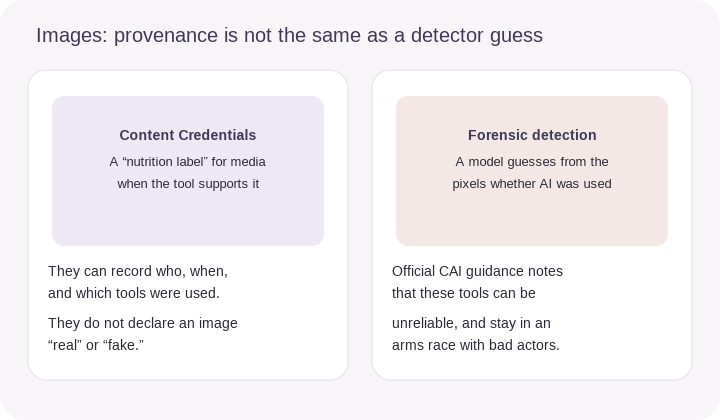
If you work with images as well as text, AI image detection in simple terms explains Content Credentials: official CAI guidance treats them as a nutrition label, not a stamp that an image is “real.”
For writers who want a free official check, with unusually clear “signals, not verdicts” language
A free official detector that, on its own site, tells users never to make an academic or employment decision on a score alone.
For writers already working in Grammarly, who need to know that scores can differ across tools
An official detector inside a writing tool, with a published warning that the percentage is not an objective source of truth and may differ from other detectors.
For editors and publishers checking content they intend to publish
An official checker aimed in part at publishers and teams. Its own site says an AI score should not be used alone for academic integrity discipline, and notes a 100-word minimum.
Google’s official guidance we opened does not say that. It focuses on quality, accuracy, spam policies and human review, not on a detector percentage.