Guide
Why false positives happen
Main keyword: AI detector false positives. This is an educational guide, not a hands-on test and not a paid ranking. Sources were checked on 2026-11-18 unless a citation says otherwise.
What “false positive” means here
In this guide, a false positive means a detector treats fully or primarily human-written text as AI-generated. Turnitin’s official blog uses that same idea: a false positive is “incorrectly identifying fully human-written text as AI-generated.” The opposite error — missing AI writing — is a false negative. Both matter. A false negative can hide undisclosed AI use. A false positive can put an honest writer, especially a student, in an unfair position.
No official page we opened claims that its false-positive rate is zero. Turnitin’s official blog says it has aimed for “a less than 1% false positive rate,” which is a vendor claim, and then immediately notes that the rate “is not zero.” GPTZero’s official FAQ says there are always edge cases in both directions. Grammarly’s official user guide says the percentage “should not be used as an objective source of truth.” QuillBot’s official page says scores are “signals, not verdicts.”
Short, predictable or highly formal text
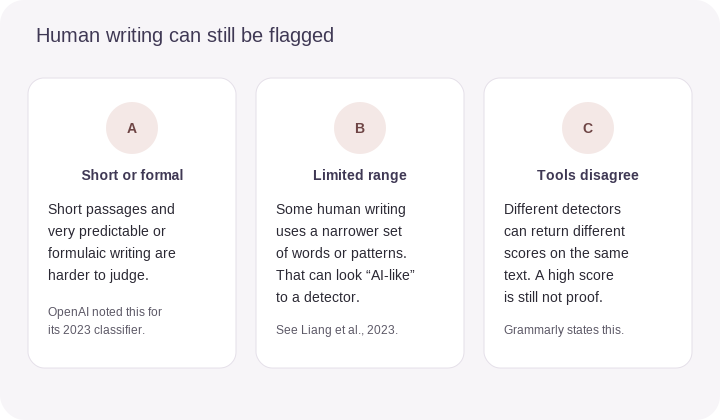
OpenAI’s official page on its withdrawn 2023 classifier said the tool was “very unreliable on short texts (below 1,000 characters)” and that “text that is very predictable cannot be reliably identified.” The company used a stark example: a list of the first 1,000 prime numbers has a correct, fixed form, so “it is impossible to predict whether [it] was written by AI or humans.” School writing is not a list of primes, but the warning still matters. Short answers, template emails, formulaic lab reports, and very regular prose give a detector less distinctive human variation to work with.
Originality.ai’s official site, checked on 18 November 2026, similarly says shorter text may affect accuracy and states a 100-word minimum. QuillBot’s official page asks for at least 80 words. Scribbr’s official FAQ recommends scanning longer pieces rather than isolated sentences or paragraphs. Those are official product limits, not tests by this site, but they all point the same way: a score on a thin slice of text is a weaker signal.
Non-native English writing: what the 2023 study actually found
Claims about non-native English writers need a source. The source this guide uses is a 2023 paper by Weixin Liang, Mert Yuksekgönül, Yining Mao, Eric Wu and James Zou, “GPT detectors are biased against non-native English writers.” We opened the arXiv abstract and PDF (arXiv:2304.02819, version 3, 10 July 2023) on 18 November 2026. The authors also point to a published version in the journal *Patterns*. The numbers below come from the arXiv PDF we actually opened, not from a guessed summary.
The authors evaluated seven widely used GPT detectors on 91 human-authored TOEFL essays from a Chinese educational forum and 88 US eighth-grade essays from the Hewlett Foundation ASAP dataset. In the PDF, the detectors showed “near-perfect accuracy for US 8-th grade essays” but “misclassified over half of the TOEFL essays as ‘AI-generated’ (average false positive rate: 61.22%).” All seven detectors unanimously identified 18 of the 91 TOEFL essays (19.78%) as AI-authored, and 89 of the 91 TOEFL essays (97.80%) were flagged by at least one detector. For the unanimously flagged TOEFL essays, the authors reported significantly lower perplexity.
They then asked ChatGPT to enrich the word choices in the TOEFL essays “to sound more like that of a native speaker.” In the PDF, the average false-positive rate fell from 61.22% to 11.77%. In the other direction, simplifying the US eighth-grade essays “as if written by a non-native speaker” raised the average misclassification rate from 5.19% to 56.65%. The authors argue that detectors “may unintentionally penalize writers with constrained linguistic expressions,” and they “caution against their use in evaluative or educational settings, particularly when they may inadvertently penalize or exclude non-native English speakers.”
This paper is important, and it is also time-stamped. It studied seven detectors as they existed for that 2023 experiment, on two specific essay sets. It does not tell you the false-positive rate of a particular commercial tool in 2026. Some vendors, including GPTZero on its official technology page, now publish their own later claims about reduced ESL bias (GPTZero states that work since April 2022 reduced its false-positive rate on TOEFL texts to 1.1%). That is a vendor claim, not an independent re-run of Liang et al. by this site. The research still stands as evidence that this kind of bias has been observed and should be taken seriously.
Editing tools, mixed drafts and disagreement between detectors
Official vendor pages also describe other routes to a false flag. Originality.ai’s official site says tools that use AI to rewrite or edit copy — the page gives some Grammarly features as an example — can cause false positives. Grammarly’s official user guide says that if you use Grammarly’s own generative rewrite, Paraphraser or Humanizer agents, “it is likely that the AI Detection agent will flag your content as AI-generated,” because those rewrites come from an LLM.
Two tools can also disagree. Grammarly’s official user guide says its scores “may differ from those of other solutions like Turnitin, GPTZero, Copyleaks, and others,” and that you should not treat a Grammarly score as a clear indication that a professor will see the same score. If two official tools can diverge, a single number is even less of a verdict. For what to do next, see If you are falsely flagged.
Frequently asked questions
Does research show that detectors are biased against non-native English writers?
A 2023 study by Liang and colleagues, in the arXiv PDF we opened, reported an average false-positive rate of 61.22% on 91 human-written TOEFL essays across seven detectors, versus much more accurate results on a set of US eighth-grade essays. That study does not, by itself, measure every tool in 2026.
Is a vendor’s “less than 1%” false-positive claim a guarantee?
No. When we mention such a figure, we label it as a vendor claim. Turnitin’s official blog, for example, publishes a “less than 1%” aim and also says the rate is not zero.
Sources checked for this guide
- Liang, Yuksekgönül, Mao, Wu and Zou, “GPT detectors are biased against non-native English writers,” arXiv:2304.02819 — We opened the arXiv abstract and the PDF (v3, 10 July 2023) on 18 November 2026. The authors point to the published Patterns article at https://www.cell.com/patterns/fulltext/S2666-3899(23)00130-7. Numbers quoted in the guides come from the arXiv PDF we opened, not from a Cell HTML full-text page.. Checked on 2026-11-18.
- Liang et al. 2023 PDF (arXiv:2304.02819). Checked on 2026-11-18.
- OpenAI, “New AI classifier for indicating AI-written text” (31 January 2023; classifier withdrawn 20 July 2023). Checked on 2026-11-18.
- Turnitin, “Understanding false positives in Turnitin AI detection”. Checked on 2026-11-18.
- GPTZero official FAQ. Checked on 2026-11-18.
- GPTZero official technology page. Checked on 2026-11-18.
- Grammarly Support, “AI Detector user guide”. Checked on 2026-11-18.
- QuillBot official AI Detector page. Checked on 2026-11-18.
- Originality.ai official homepage. Checked on 2026-11-18.
- Scribbr official AI Detector page. Checked on 2026-11-18.
Related guides
- If you are falsely flagged — Stay calm, keep your drafts, read the policy, and ask for a conversation. A score is not proof, and official sources say it should not stand alone.
- How AI detectors work — Perplexity and burstiness are useful ideas to understand, but many current tools describe classifiers or other methods. A score is still not proof.
- How teachers can use results fairly — Treat a flag as a prompt for professional judgement, not a misconduct decision. Official sources say the score should not stand alone.
All guides · All sources · How we review · Tools we point to