Editorial status: AI-drafted text — pending human fact-check. Product facts that name a vendor were checked on official websites on 2026-11-18. We have not done hands-on testing unless a listing’s testing notes say otherwise. This notice will be removed only after a person has reviewed the wording.
Short, sourced definitions of terms used in the guides. These are educational explanations, not vendor marketing copy and not a claim that every detector uses the same method.
Main keyword: AI detection glossary. Definitions were checked against the cited pages on 2026-11-18.
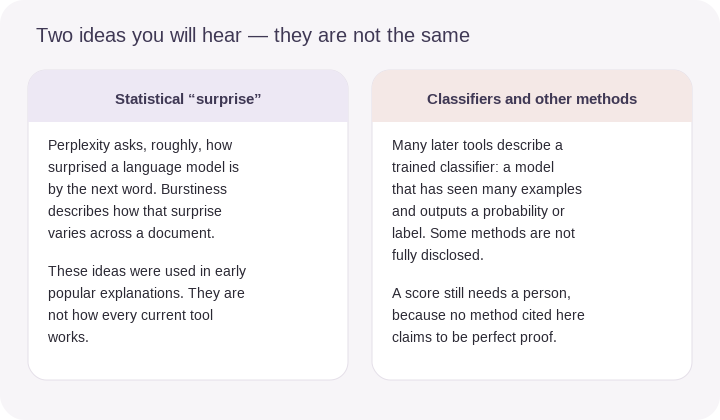
Many popular explanations still start with perplexity. Current tools often use other methods. Original diagram.
AI text detector
A program that takes writing and returns a score, label or highlight meant to estimate whether the text is AI-generated, human-written, or mixed. Official vendor pages cited on this site treat the output as a signal, not as complete proof.
A statistical measure of how surprised a language model is by the next word, given the words before it. Lower perplexity means the wording was more predictable to that model. An official GPTZero support article uses this idea as an explanation of an older method. Predictable human writing can also have low perplexity.
In official GPTZero support wording, burstiness is a measure of how much perplexity varies across a document. The older popular idea was that human writing often varies more than evenly generated text. GPTZero’s official article says that as of autumn 2023 it no longer uses burstiness (or perplexity) for detection.
A model trained on examples so that it can assign a new input a label or probability, such as “likely AI-written.” GPTZero’s official technology page describes an end-to-end deep-learning classifier. OpenAI’s withdrawn 2023 tool was also described as a classifier fine-tuned on pairs of human and AI text.
In this site’s guides, a false positive means human-written text is treated as AI-generated. Turnitin’s official blog uses that definition for fully human-written text. Official pages and published research cited here show that the error happens, and that the rate is not zero.
AI-written or AI-assisted text that a detector treats as human, or otherwise fails to flag. Official sources note that AI text can be edited to evade detection and that tools can miss AI writing.
A figure or ranking published by a company about its own product, such as a 99% accuracy claim. This site may report such a claim with a source and date, but it is not a test we ran and it does not cancel the same vendor’s warnings about limits.
Verifiable metadata, based on C2PA standards, that can record who produced a piece of content, when, and which tools were used. Official CAI guidance calls this a “nutrition label” and says it is not intended to declare whether content is “real.” When an AI tool supports the standard, credentials can indicate that an image was generated with AI.
The Coalition for Content Provenance and Authenticity, described on the official CAI page as a standards organisation (under the Linux Foundation’s Joint Development Foundation) that develops technical standards for certifying the source and history of media.
A record of origin and history for a piece of media — who, when, and which tools — as distinct from a forensic guess that inspects pixels or wording and returns a score. Official CAI guidance is about provenance and transparency, not a simple real-or-fake stamp.
A search for text that matches other sources in a database. Official vendor pages distinguish this from AI detection, which looks for patterns associated with machine writing rather than a copied source. You can have plagiarism without AI, and undisclosed AI use without a plagiarism match.
In Jisc’s official principles for FE colleges, the idea that if an AI system is used in a way that affects learner outcomes — including AI detection in assessment — learners and staff should have clear guidance on how to contest the output if they feel unfairly disadvantaged.
An inaccurate statement produced by a generative model that is predicting likely words rather than retrieving a checked fact. Google’s official Search guidance uses this term and tells publishers to fact-check AI-generated content before publishing. The MLA Style Center also warns that AI tools can invent sources.
This site stores your cookie choice in your browser (localStorage) so the banner does not keep reappearing. This site uses Google AdSense. Google and its partners may use cookies to serve ads, including personalised ads, based on your visits to this and other sites. You can opt out at Google Ads Settings and www.aboutads.info. Read the Privacy Policy. Datenschutzhinweis: Ihre Wahl wird nur auf diesem Gerät gespeichert.