Guide
AI detection vs plagiarism checking
Main keyword: AI detection vs plagiarism. This is an educational guide, not a hands-on test and not a paid ranking. Sources were checked on 2026-11-18 unless a citation says otherwise.
They are not the same check
People often say “the AI plagiarism checker” as if one tool did one job. Official vendor pages we opened treat the jobs as different. Scribbr’s official AI Detector page includes a short comparison: AI detectors “try to find text that looks like it was generated by an AI writing tool” by measuring characteristics such as “sentence structure and length, word choice, and predictability — not by comparing it to a database of content.” A plagiarism checker, on the same page, “try to find text that is copied from a different source” by comparing the text to a database of web pages, articles and journals.
Scribbr’s official FAQ is explicit: its AI content checker “can only identify AI-generated, AI-refined, and human-written content,” while “Our Plagiarism Checker can help prevent unintentional plagiarism.” QuillBot’s official detector page also says its AI detector “does not scan text for plagiarism.” Grammarly’s official product page discusses plagiarism checks as a separate feature in the same suite. Turnitin has long been known for similarity checking and, separately, for an AI writing indicator; its official false-positives blog discusses the AI-writing feature as its own capability, and says the company does not determine misconduct in either space.
Why the difference matters in a difficult conversation
A similarity report can point to a source that you can open and compare. You and a student can look at the overlapping passages together. That does not automatically prove dishonest intent — citation mistakes happen — but it is a kind of evidence that can be inspected. An AI detector score does not point to a source in that way. It is a model’s estimate, and official pages warn that the estimate can be wrong.
Mixing the two ideas can make a conversation less fair. “This looks like plagiarism from ChatGPT” is a claim that needs unpacking. If the worry is copied wording from a webpage, a similarity check and the sources themselves are the relevant evidence. If the worry is undisclosed AI writing, a detector score may be a prompt, but — as Jisc’s official principles say — it cannot conclusively prove the text was written by AI. Process evidence, disclosure rules and a chance to respond still matter. See How teachers can use results fairly.
You can have one problem, the other, both, or neither
A human-written essay can still contain copied sentences. An AI-written essay can be original in the narrow sense that those sentences are not sitting in a plagiarism database — and can still violate a rule against undisclosed AI use. A student can also use AI to paraphrase a source in a way that raises both issues. Official tools sometimes sell both checks; that convenience should not hide the fact that the questions remain distinct.
Citation practice is part of the human side of this. The MLA Style Center’s updated guidance tells writers to cite generative AI when they incorporate its content, and to go and check the secondary sources a tool mentions, because AI systems can invent sources. A hallucinated citation is a source problem as well as an AI-use problem. A detector score will not fix it.
Frequently asked questions
If a plagiarism checker finds nothing, does that mean the text is human?
No. A plagiarism checker looks for matching sources. Official vendor pages say AI detection is a different check, and even then a score is not proof of authorship.
If an AI detector flags a paper, does that mean it was plagiarised?
No. Those are different claims. A flag is not evidence of copying from a source, and official pages warn that flags can be wrong.
Sources checked for this guide
- Scribbr official AI Detector page. Checked on 2026-11-18.
- QuillBot official AI Detector page. Checked on 2026-11-18.
- Grammarly official AI Detector page. Checked on 2026-11-18.
- Turnitin, “Understanding false positives in Turnitin AI detection”. Checked on 2026-11-18.
- Jisc, “Principles for the use of AI in FE colleges”. Checked on 2026-11-18.
- MLA Style Center, “How do I cite generative AI in MLA style? (Updated and Revised)” (published 13 August 2025). Checked on 2026-11-18.
Related guides
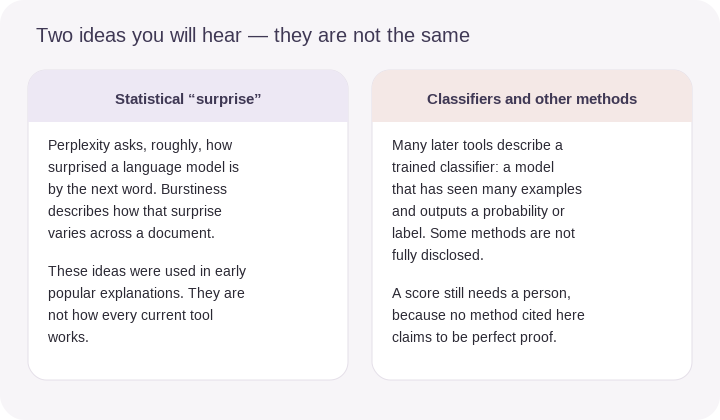
- How AI detectors work — Perplexity and burstiness are useful ideas to understand, but many current tools describe classifiers or other methods. A score is still not proof.
- Policy and ethics of AI detection — Fair policy states what AI use is allowed, treats detector output as contestable, and does not let a score stand alone.
- AI detection for students: what a score does and does not mean — For students, a detector score is a signal, not a grade and not a finding of cheating. Read your course policy, keep your drafts, and disclose AI use if you used it.
All guides · All sources · How we review · Tools we point to