Guide
How to read an AI detector score
Main keyword: how to read an AI detector score. This is an educational guide, not a hands-on test and not a paid ranking. Sources were checked on 2026-11-18 unless a citation says otherwise.
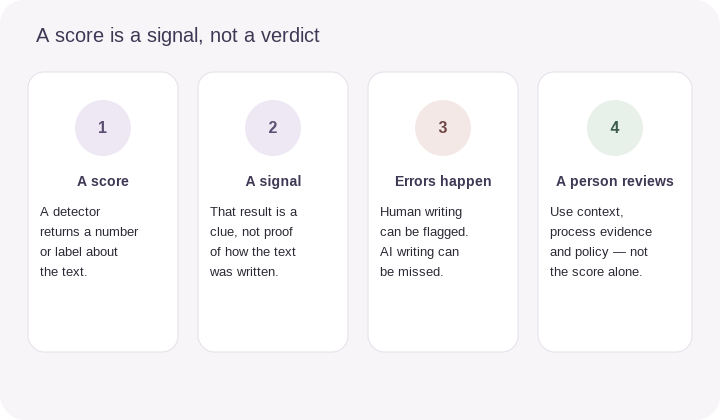
What the number is usually claiming
Most consumer-facing detectors you will meet return a percentage, a label such as “human,” “AI” or “mixed,” or highlights on sentences. Grammarly’s official user guide, checked on 18 November 2026, says its score “represents the percentage of scanned text that is likely AI-generated,” and then warns that the feature “is not 100% accurate and should not be used as a definitive assessment.” It also says “the score itself should be viewed as an average estimate rather than a definitive percentage assessment.” Scribbr’s official FAQ describes its AI score as a percentage “indicating how much of the text contains content likely written or refined using AI tools.”
Those are estimates produced by a model, not a measurement of keystrokes. GPTZero’s official FAQ describes a document classification of HUMAN_ONLY, MIXED or AI_ONLY, with probabilities and a confidence category. The same FAQ says results should not be used to punish students. QuillBot’s official page says: “Scores are signals, not verdicts.”
Four questions to ask before you react
First, how long is the text? Official pages repeatedly treat short input as weaker evidence. OpenAI said its 2023 classifier was very unreliable below 1,000 characters. Originality.ai states a 100-word minimum. QuillBot asks for at least 80 words. Scribbr recommends longer pieces rather than isolated sentences.
Second, what does this vendor officially warn? If the official page says the score is not an objective truth, not a misconduct finding, or not to be used alone, believe that warning before you believe the marketing number next to it. Vendor accuracy claims such as “99%,” “less than 1% false positives,” or a ranking on a benchmark are claims from that vendor unless an independent paper you can open says otherwise. The RAID paper we opened notes that many tools claim “99% or more” and then finds that detectors can be fooled under more challenging conditions.
Third, would another tool necessarily agree? Grammarly’s official user guide says scores may differ from Turnitin, GPTZero, Copyleaks and others, and that you should not treat a Grammarly result as a clear indication of what a professor’s preferred detector will show. Disagreement is a reason to slow down, not to average the numbers into a fake certainty.
Fourth, what else do you know? Process evidence, disclosure, the assignment design, and the writer’s usual work all sit outside the score. Turnitin’s official blog asks instructors to use professional judgment and context because the false-positive rate is not zero. For high-stakes settings, see What AI detectors cannot reliably prove.
A high score is not proof, and a low score is not a clean bill of health
A high score can be a reason to start a careful conversation. It can also be a false positive, including on human writing that is short, formal, or written in a narrower linguistic range, as discussed in the false positives guide. A low score can mean the tool did not find a strong AI-like pattern; it cannot, on the official wording cited here, prove that no AI was used. Official sources also note that AI writing can be edited or paraphrased in ways that make detection harder. OpenAI said AI-written text can be edited to evade its classifier. Jisc says detection tools “are easy to defeat.” GPTZero’s official FAQ says its classifier is not trained to identify AI-generated text after it has been heavily modified.
If you used AI and you are looking at a score, official ethics language from vendors such as QuillBot is to disclose the use rather than revising only to change the number. If you did not use AI and you have been flagged, take the falsely flagged guide next.
Frequently asked questions
If two detectors disagree, which one is right?
Neither score is automatically “the truth.” Grammarly’s official user guide says scores may differ across tools. Treat disagreement as a reason not to rely on a single number.
Does 0% mean no AI was used?
No official page cited here treats a low score as proof. Detection can miss AI writing, especially after editing, and vendors warn that tools are not fully reliable.
Sources checked for this guide
- Grammarly Support, “AI Detector user guide”. Checked on 2026-11-18.
- Scribbr official AI Detector page. Checked on 2026-11-18.
- QuillBot official AI Detector page. Checked on 2026-11-18.
- GPTZero official FAQ. Checked on 2026-11-18.
- OpenAI, “New AI classifier for indicating AI-written text” (31 January 2023; classifier withdrawn 20 July 2023). Checked on 2026-11-18.
- Originality.ai official homepage. Checked on 2026-11-18.
- Turnitin, “Understanding false positives in Turnitin AI detection”. Checked on 2026-11-18.
- Dugan et al., “RAID: A Shared Benchmark for Robust Evaluation of Machine-Generated Text Detectors,” arXiv:2405.07940. Checked on 2026-11-18.
- Jisc, “Principles for the use of AI in FE colleges”. Checked on 2026-11-18.
Related guides
- What AI detectors cannot reliably prove — Detectors cannot reliably prove that a person used AI, or that they did not. Official and research sources describe false positives, missed AI writing, and easy evasion.
- Why false positives happen — A false positive is human writing flagged as AI. Research and official vendor pages show this can happen, including for some non-native English writing.
- When writing is a mix of human and AI work — Many real drafts are mixed. Official tools sometimes offer a “mixed” label, but a score still cannot reliably separate every kind of help from authorship.
All guides · All sources · How we review · Tools we point to